.png)
.jpg)


The Galileo TrakWheel could be the solution you’ve been searching for: A tire that slashes compaction and boosts traction the harder you work it.

As a traction consumer, you’re used to balancing the benefits and the drawbacks of a particular track or tire setup. You might love the incredible flotation tracks offer in wet conditions, but wince when you think about the maintenance costs—or when you discover that you’re still compacting your soil thanks to areas of high pressure beneath the midrollers.
Likewise, you might marvel at the traction you’ve gained with a new set of VF radials, but struggle to determine the right tire pressure to run, during different applications and loads, in order to capitalize on the tires’ full potential.
Traction is like everything else in life: it demands compromise.
Until now.
NTS Tire Supply is excited to present you Galileo TrakWheel tires. We’ve reviewed the early testing data and we’ve talked with the company co-founder and CEO to gain insights into this revolutionary tire technology.
The TrakWheel could be the solution you’ve been searching for: A tire that slashes compaction and boosts traction the harder you work it . . . without any of the negative side effects of either tracks or high-dollar radials. And even with its unique construction, the TrakWheel mounts on standard rims—you don’t need custom rims or extra hardware to make the switch to the pneumatic TrakWheel. (Airless models may require additional hardware.)
One word of caution before you read on: Galileo TrakWheel (formerly called CupWheel) tires have been in development for a decade or more at this point. The only Galileo tires we've actually been able to stock in our warehouse were the company's previous-generation skid steer tires. So, as for January 2026, when we last updated this article, we have limited experience with these tires in real-world conditions.
An Inverted Design for a Longer Footprint
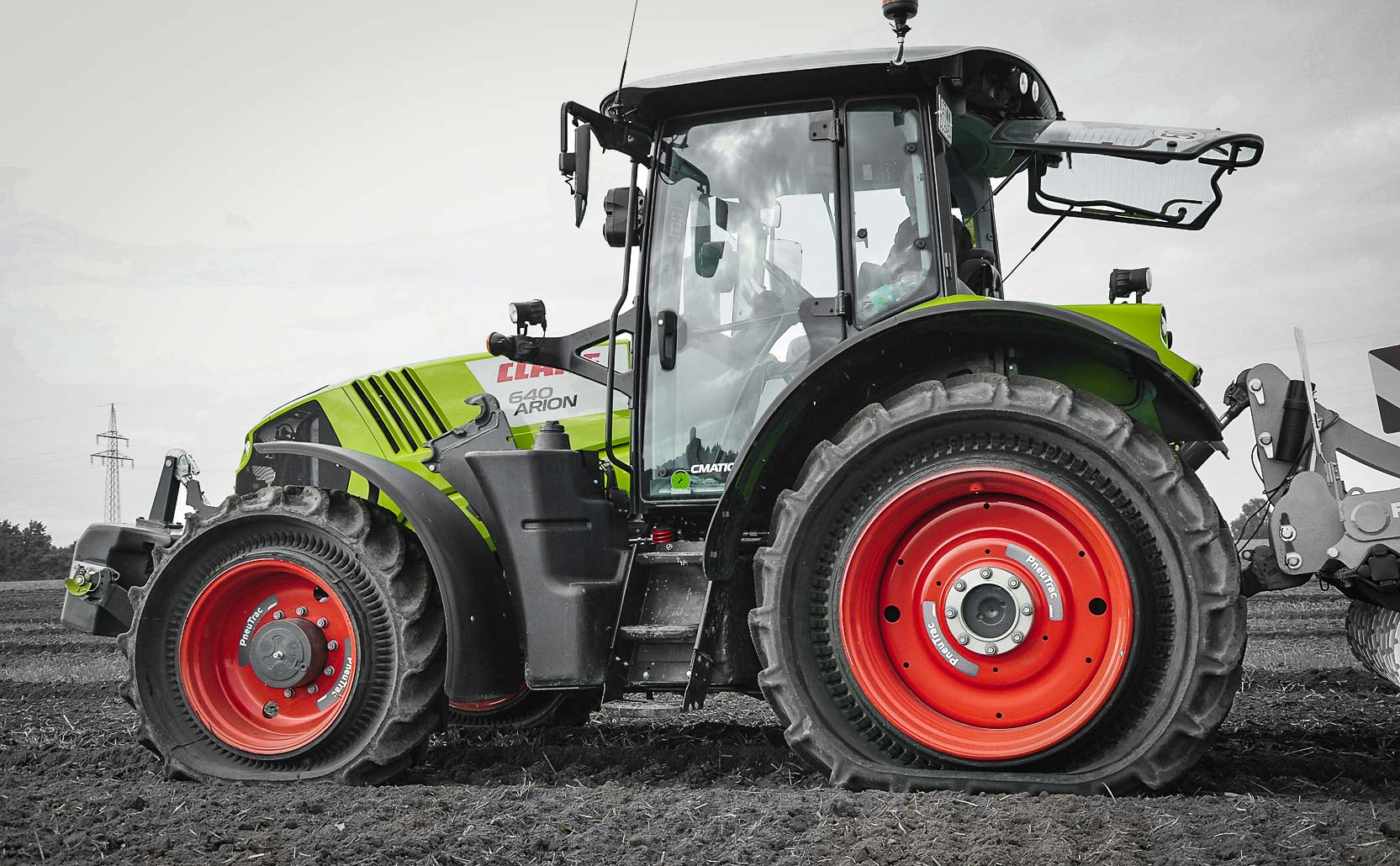
The TrakWheel's unique “hinged” double-V inverted sidewall drives its performance. The TrakWheel extends its tread to create a long footprint like a track, but it maintains uniform ground pressure like a radial tire. At the same time, the V sidewall ensures excellent lateral stability, which means more predictable handling and more secure travel across hillsides, on slopes, and down the road as well.
.jpg)
A Uniform Footprint. Always.
The footprint of a standard tire becomes more distorted as the tire deflects. And this is true even with the latest IF and VF radials too. Without enough tire pressure, the tread will begin to buckle under the footprint during high-load applications due to the tire’s construction. This creates areas of greater compaction along the tire’s edges, gives you less traction when you need it the most, and robs you of stability and ride quality. With the TrakWheel's unique design, these problems are part of your past. The TrakWheel is designed to maintain a long, uniform footprint at extremely low inflation pressures (or entirely airlessly).
The Making of a Game Changer for Your Operation
As we’ve said many times before, tires play an important role in safeguarding the efficiency of your farm and the long-term health of your soil. Avoiding deep-soil compaction is critical for achieving top yields. And you probably don’t want to spend more time than necessary tinkering with your tires to find the optimum setup for your operation on any given day. This is why we are so excited about the Galileo TrakWheel. We believe this new technology, in development for over 10 years, will have a positive impact on your bottom line in many ways. (The TrakWeel began its life named CupWheel, but Galileo decided to change its name in 2025.)
10 Benefits TrakWheels Will Bring to Your Farm
1. Larger Footprint + Increased Traction
The TrakWheel delivers a track-like footprint with uniform weight distribution across the footprint. When you view the TrakWheel from the side you’ll notice its omega shape as the tire’s bottom flexes and flattens out with ground contact. Unlike a track, however, there’s no high-pressure points from midrollers. Uniform air distribution and a larger footprint—up to 53% larger than a standard radial—leads to enhanced efficiency and less compaction. Its double-V-shaped structure retains its rolling circumference even with very low air pressure. On the other hand, a radial tire will lose circumference as the tire deflects. This means you travel a shorter distance with every tire revolution, which lowers your efficiency. Because the TrakWheel retains its rolling circumference, independent of the amount of deflection, your equipment will travel further per tire revolution, enabling you to do more work while burning less fuel.
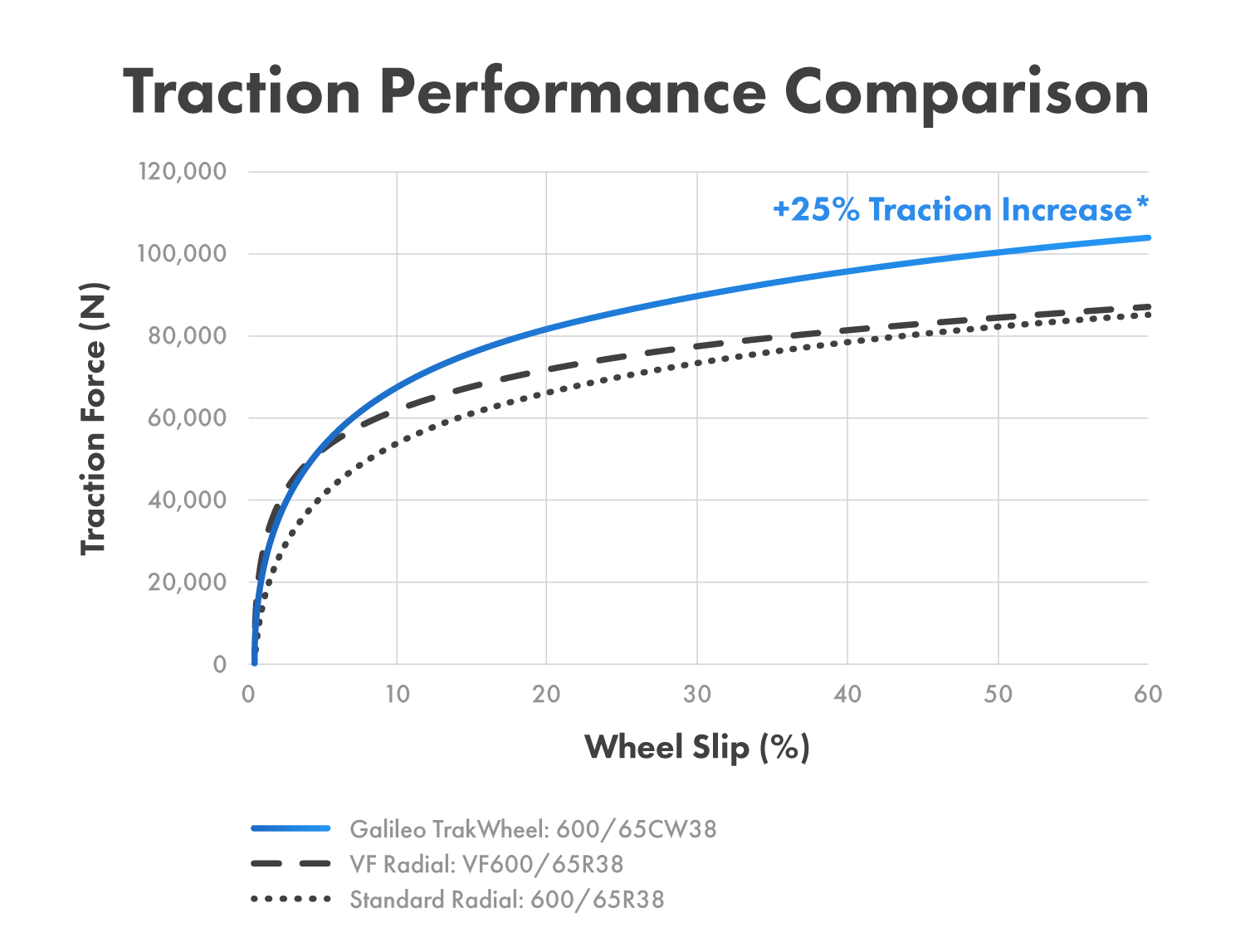
Trials have shown that the TrakWheel delivers a larger increase in traction as the amount of traction required increases. What does this mean for you? The TrakWheel appears most likely to benefit your operation in high-load and high-traction applications. Think tillage, pulling a heavy manure spreader, or harvesting with your combine, for example. During testing, the TrakWheel has demonstrated an increase in traction up to 40% over standard radial tires (in sandy soils) and 15% greater traction when compared with an IF radial. The TrakWheel truly offers the best of both tracks and radials in one package.
2. Enhanced Stability
Testing has revealed 167% higher stability with the TrakWheel when compared to a standard tire. The TrakWheel's double-V sidewalls prevent side-to-side motion that curbs steering ability. The TrakWheel's enhanced stability makes your tractor easier to maneuver in the field, especially on slopes. And for high-speed road travel, you’ll find it easier to stay between the lines (and mailboxes).
3. Less Compaction
Any time you avoid compaction and rutting you preserve your soil and your yields. Deep soil compaction can take a bite out of your profits for a decade or more. The TrakWheel's track-like footprint and uniform ground pressure provides the best solution to carry heavy loads without destroying your soil and yields.
4. Smoother Ride
This is the first amazing difference customers notice about the TrakWheel, according to CEO Alon Hayka. You’ve been used to rough riding skid steers and tractors your entire life; can you imagine what it would feel like to have a “suspension” beneath your machine? With the TrakWheel's sidewall designed for flex, you can travel over grooves and ridges without feeling every bump in the cab. And for skid steer loader work, you’ll experience less bouncing and rocking when dumping and maneuvering in tight spaces.
5. Run Flat for Easier Fixes
If a flat strikes in the field, even on your high-horse tillage machine, you’re able to drive at a slow speed back to your yard to fix the flat. While the TrakWheel isn’t designed to pull with no air pressure, you can limp back to fix a flat in the comfort of your yard instead of messing around in the field. If you do experience a flat, standard repair methods work with the TrakWheel—no additional equipment required.
6. Increased Durability
Even top-dollar IF and VF radials are susceptible to stubble damage on their sidewalls. Thanks to the TrakWheel's double-V sidewall that flexes to the inside of the rim, there’s nowhere for stubble to strike on the sidewall. And thanks to its uniform ground contact area, the TrakWheel's tread will wear evenly and extend the tire’s life. The TrakWheel utilizes existing rubber compounds, but has a stiffer compound in the sidewall than a standard tire. In fact, the sidewall is so stiff that it would be difficult for a stray obstacle to penetrate it.
7. Safer, Smoother Roading
At NTS Tire Supply we’ve seen central tire inflation systems grow in popularity with the latest generation of IF and VF radials. With a TrakWheel, however, there’s less need to vary your inflation pressure between field operations and road travel to optimize tire performance. Because of the TrakWheel's unique double-V cross section, the tire accumulates less mechanical strain when compared to a standard tire. So you don’t need to worry about increasing air pressure for road travel in most situations. However, to get the longest lifespan out of your TrakWheel, increasing your air pressure is recommended. The TrakWheel's smooth ride and secure steering performance make guiding large equipment down small country roads less of a chore at the end of a long day.
8. Use Your Existing Rims
Switching is easy. The TrakWheel mounts on standard rims without any modifications. And it doesn’t place additional stress on the rims or other hardware either.
9. Self Cleaning
Tires with more flex tend to clean out better. The TrakWheel's extreme flexing and self-cleaning properties mean less of a mess on the road and in your yard.
10. Easy Inflation
With a 30% smaller air chamber compared to a standard tire, adding air to the TrakWheel is faster. Want to know if your TrakWheel is inflated properly? You no longer need to know axle load, operating speed, machine type, number of tires per axle, tire size, load index, and speed rating in order to calculate the proper inflation. With the TrakWheel, you can tell the proper inflation just by looking at it. If the inner cone and outer cone are touching, you add more air until there is a slight gap between the two cones. That’s all.
.jpeg)
If you’re thinking “there’s got to be a catch,” you’re not alone. Because the TrakWheel is just starting to hit the market (more on that below), it hasn’t withstood the variety of rigorous chores that our customers put their tires through. That said, the TrakWheel has been extensively tested by independent agencies for the past 8 years as it has moved from concept to a market-ready product. As we know from experience, it’s impossible to test every scenario. Only real-world use can truly prove how good any particular tire performs in the real world.
Can You Buy a TrakWheel Tire Today?
At the time we reviewed this article (January 2026), we didn't have inventory for any of Galileo's TrakWheel tires in our warehouse. This includes the AgriTrak, a pneumatic tire meant for tractors; the IrriTrak, an airless tire for mounting on irrigation pivots; the TeleTrak, an airless tire intended for telehandlers; and the SkidTrak, an airless tire for mounting on skidsteers. In fact, the only Galileo tire we've ever been able to stock is the previous generation of the SkidTrak—the SkidCup. Unlike the SkidTrak, the SkidCup was a pneumatic tire. Our customers weren't completely crazy about the performance of the SkidCup and, quite frankly, we had a tough time rolling them out of our warehouse.
We will check back with Galileo and keep you posted if and when any of the TrakWheel tires become available in the U.S. market. Years ago, the company was going to focus on bringing tires to market to address high-horsepower tractor and combine needs—two applications in which the TrakWheel may pay huge dividends for your operation if the promised benefits of the tires pan out.
References
You may also like...